
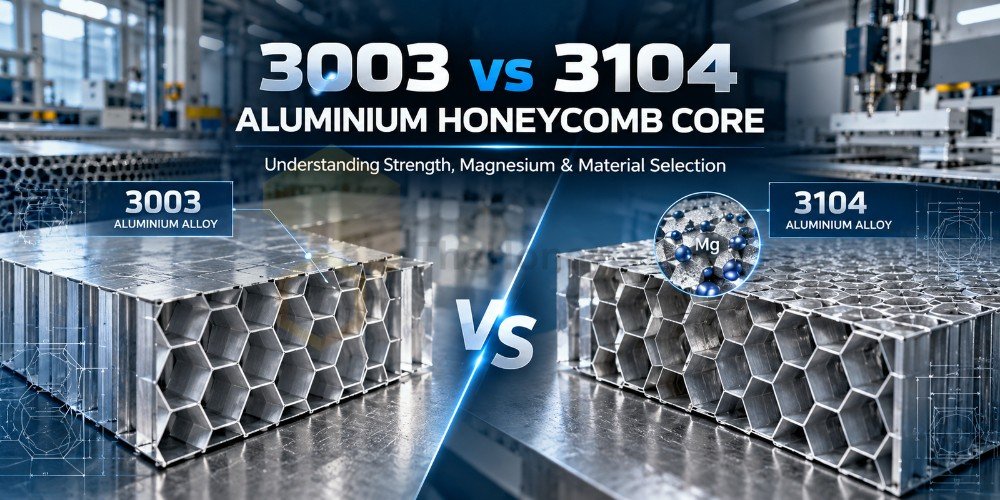
When ordering an aluminium honeycomb core, specifying the alloy is an important part of getting the performance you need. Many buyers choose 3003 aluminium because it is widely used in honeycomb structures. However, a panel manufacturer or core supplier may recommend 3104 aluminium when the application requires different mechanical properties.
Understanding 3003 vs 3104 aluminium honeycomb helps you decide whether the recommended change is necessary or whether your original specification is sufficient.
1. What Is the Difference Between 3003 and 3104 Aluminium?
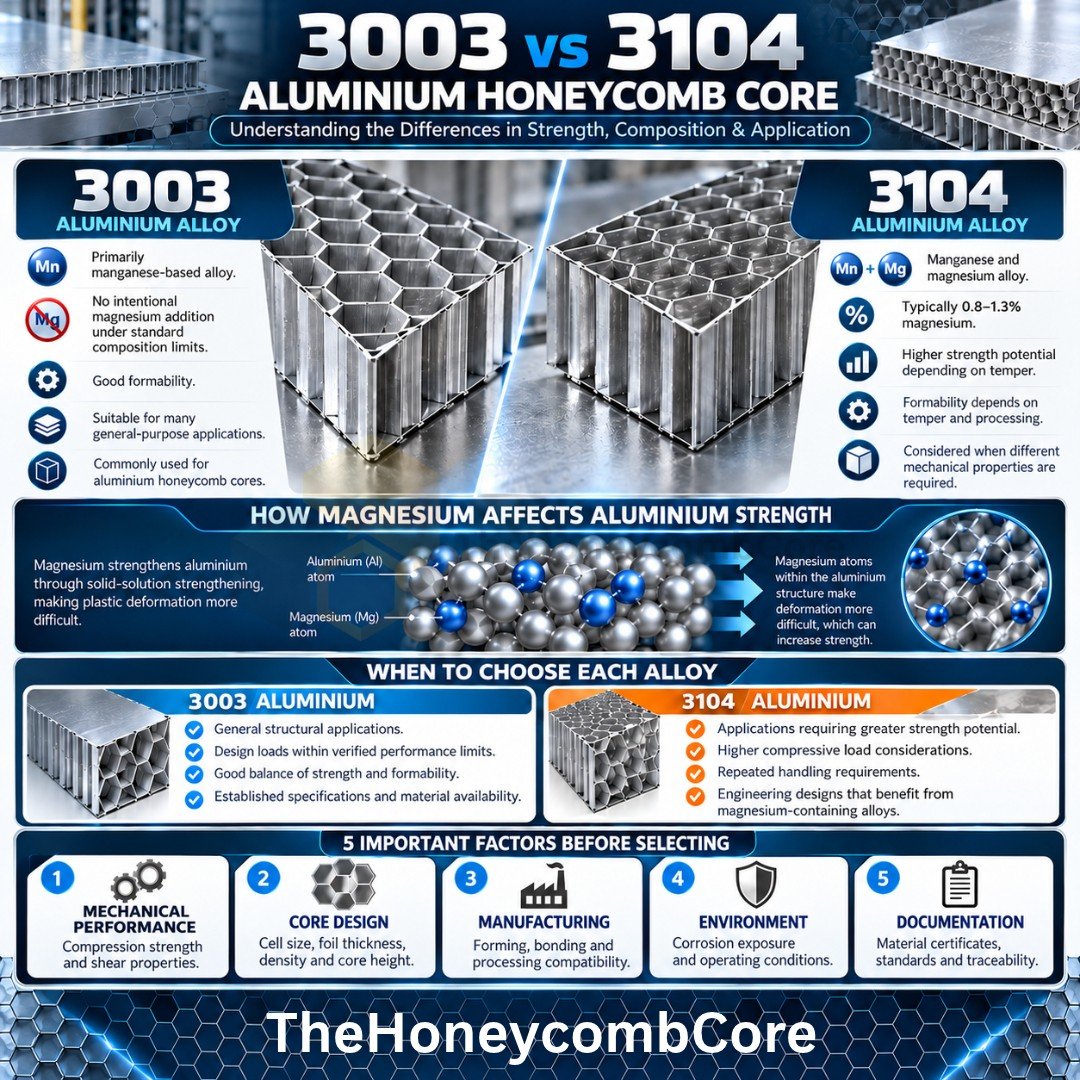
Both alloys belong to the 3000 series, which primarily uses manganese as an alloying element. The main difference is that 3104 also contains a significant amount of magnesium, which can improve strength.
| Property | 3003 Aluminium | 3104 Aluminium |
|---|---|---|
| Main alloying element | Manganese | Manganese and magnesium |
| Magnesium content | No intentional addition in standard composition | Typically 0.8–1.3% |
| Strength potential | Suitable for many general-purpose applications | Can provide higher strength, depending on temper |
| Formability | Generally good | Depends on temper and processing |
| Typical consideration | General structural and formed components | Applications needing a different strength and forming balance |
Actual properties depend on the applicable material standard, temper, thickness and manufacturing process.
2. How Does Magnesium Affect Aluminium Strength?
Magnesium strengthens aluminium through solid-solution strengthening. In simple terms, magnesium atoms within the aluminium structure make plastic deformation more difficult, which can increase the material's strength.
Standard 3104 composition contains approximately 0.8–1.3% magnesium, while 3003 relies mainly on manganese and has no intentional magnesium addition under its standard composition limits.
This difference can make 3104 attractive when a honeycomb core needs improved resistance to deformation. However, magnesium content alone does not determine the final core performance. Temper, foil thickness, cell size, core density and manufacturing quality also matter.
3. Why Might a Core Supplier Recommend 3104 Instead of 3003?
Consider an illustrative purchasing scenario: a buyer specifies 3003 aluminium honeycomb core for a lightweight sandwich panel. During the design review, the supplier learns that the panel must withstand higher compressive loads and repeated handling.
The supplier recommends evaluating 3104 because its magnesium content can offer greater strength potential. The buyer should then compare the proposed core's compression strength, shear properties, density and bonding performance against the original requirements.
This does not mean 3104 is automatically better. The recommendation is useful only if the alternative alloy delivers a measurable benefit for the intended application.
When evaluating 3003 vs 3104 aluminium honeycomb, request technical data for both options rather than relying on the alloy designation alone.
4. When Is 3003 Aluminium Still Enough?
3003 can remain a practical choice when the panel design does not require the additional strength potential of a magnesium-containing alloy.
It may be suitable when:
- The design loads are within the core's verified performance limits.
- The panel needs a balance of strength, formability and corrosion resistance.
- The specified cell size and core density already meet the design requirements.
- The project prioritises established specifications and material availability.
- Testing confirms that the finished sandwich panel meets its performance targets.
For many applications, changing alloys without a clear engineering reason may add complexity without providing a meaningful benefit.
5. Does 3104 Change the Weight or Cost?
Switching from 3003 to 3104 does not automatically make a honeycomb core lighter or heavier in a meaningful way. Both are aluminium alloys with broadly similar base-metal densities. Finished core weight depends heavily on foil thickness, cell size, expansion quality and core density.
Cost also varies with supplier availability, processing requirements, order quantity and the requested mechanical properties. A stronger alloy may allow design adjustments in some applications, but any reduction in material use must be validated through engineering calculations and testing.
Ask suppliers to compare the price per core specification, not simply the price per kilogram.
6. How to Choose the Right Alloy for Your Panel
Before accepting a proposed alloy change, compare the following:
- Mechanical performance: Compression, shear and relevant panel-level test results.
- Core design: Cell size, foil thickness, density and core height.
- Manufacturing compatibility: Forming, bonding and any downstream processing requirements.
- Environmental requirements: Corrosion exposure and operating conditions.
- Documentation: Material certificates, applicable standards and traceability.
The Honeycomb Core can be consulted about available core materials and specifications to help identify options for your application.
The best choice in the 3003 vs 3104 aluminium honeycomb comparison is the alloy and core configuration that meets your verified engineering requirements without unnecessary cost or complexity.
Frequently Asked Questions
1. Is 3104 aluminium stronger than 3003?
3104 can offer higher strength because it contains magnesium, but the actual comparison depends on temper, processing and material form.
2. Why does 3104 contain magnesium?
Magnesium contributes to strengthening and influences the alloy's mechanical and forming characteristics.
3. Is 3003 aluminium suitable for honeycomb cores?
Yes. It is commonly used for aluminium honeycomb cores and can suit many applications when its verified properties meet the design requirements.
4. Should I change from 3003 to 3104 if my supplier recommends it?
Ask for the engineering reason, comparative test data and confirmation that the alternative meets your specifications before approving the change.