
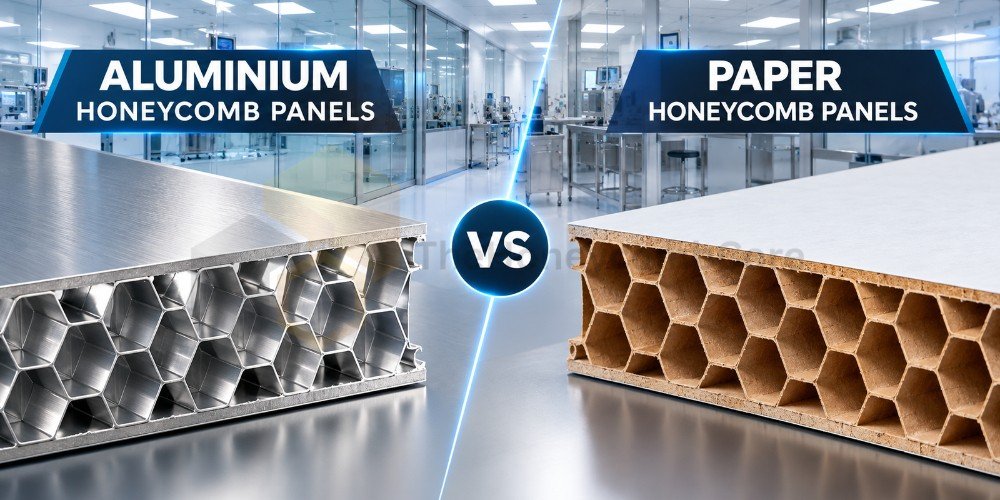
Choosing the right panel core is an important decision when designing a cleanroom. The material affects structural strength, fire performance, moisture resistance, installation weight and overall cost. Aluminium and paper honeycomb panels are both lightweight options, but they serve different needs.
For pharmaceutical facilities, laboratories and other controlled environments, aluminium honeycomb panels are often considered for their rigidity, durability and suitability for use in cleanable panel systems. Paper honeycomb panels may also be considered for dry, lower-demand applications, provided the complete panel assembly meets the required structural, fire safety and hygiene specifications.
1. Strength and Impact Resistance
Aluminium honeycomb cores feature a hexagonal metal structure that provides good stiffness with relatively low weight. When bonded between suitable face sheets, they can form rigid panels that resist everyday impacts and maintain a stable surface.
Paper honeycomb cores also provide structural support, but their performance depends on the paper grade, bonding, face sheets and overall panel construction. They may be less suitable for areas exposed to repeated impacts or demanding maintenance activities.
For pharmaceutical environments, aluminium honeycomb sandwich panels may offer advantages in rigidity and durability when properly engineered. However, impact resistance depends on the face sheets, core geometry, adhesive bonding and overall panel construction. Cleanability and contamination control depend primarily on the exposed surfaces, sealed joints and panel system design.
2. Fire Performance
Fire performance is an important factor in cleanroom design. Aluminium is generally classified as a non-combustible metal, while untreated paper is combustible. However, an aluminium honeycomb core does not automatically make the finished sandwich panel non-combustible or fire-rated. The fire performance of the complete panel system depends on its face sheets, adhesives, coatings, edge details, joints and installation configuration.
| Factor | Aluminium Honeycomb | Paper Honeycomb |
|---|---|---|
| Core behaviour | Non-combustible metal | Combustible paper |
| Fire performance | Depends on the complete panel assembly | Depends on treatment and panel construction |
| Verification | Check the tested assembly rating | Check the tested assembly rating |
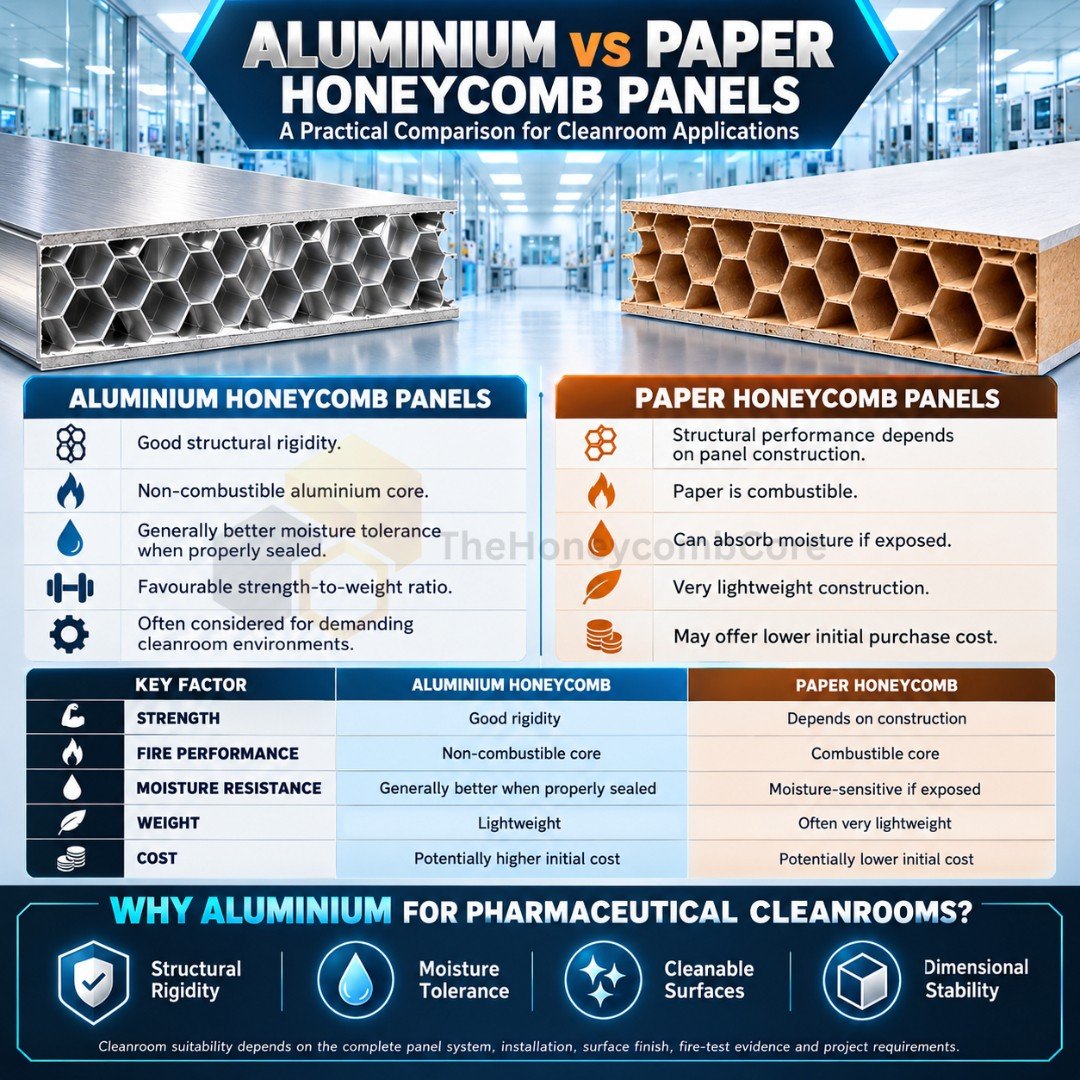
Always request relevant fire-test reports and confirm that the selected panel complies with local building codes and project requirements.
3. Moisture Resistance and Hygiene
Cleanrooms require panel surfaces that can withstand routine cleaning and disinfection without deterioration. Aluminium honeycomb cores generally offer better resistance to moisture-related core degradation than untreated paper honeycomb when incorporated into properly enclosed and sealed panel systems. However, moisture entering through damaged joints, exposed edges or failed seals may still cause corrosion, adhesive degradation or other panel damage.
Paper honeycomb cores can absorb moisture if water reaches the core, potentially affecting dimensional stability, bonding performance and long-term durability. Moisture-resistant treatments and appropriate sealing may improve their performance, but suitability must be verified for the intended operating conditions.
For pharmaceutical facilities that undergo frequent cleaning or disinfection, aluminium cores with compatible, sealed facings can provide a more durable solution. The complete panel system must also be compatible with the cleaning chemicals used.
4. Weight and Installation
Both materials are designed to provide structural support without the weight of solid panels.
Paper honeycomb panels are often very lightweight, making them easier to handle and economical for basic partitions. Aluminium honeycomb panels also offer a favourable strength-to-weight ratio while providing greater rigidity in many configurations.
The actual weight depends on panel thickness, core density, face-sheet material and overall dimensions. Comparing technical data sheets is more reliable than choosing based on core material alone.
5. Cost and Long-Term Value
Paper honeycomb panels may offer a lower initial purchase cost in certain configurations, particularly for dry, lower-demand applications. However, pricing depends on the paper grade, protective treatments, facing materials, manufacturing process and required certifications.
Aluminium honeycomb panels may have a higher initial cost depending on the core specification and overall panel construction. In demanding environments, appropriately designed aluminium honeycomb panels may provide long-term value through their rigidity, moisture tolerance and durability. Actual service life and maintenance requirements depend on the complete panel system and operating conditions.
When comparing costs, consider installation, maintenance, expected service life and the consequences of damage or contamination—not just the initial purchase price.
6. Why Aluminium Honeycomb Panels Are Considered for Pharmaceutical Cleanrooms
Pharmaceutical cleanrooms require panel systems that support contamination control, smooth and cleanable surfaces, chemical resistance and repeatable cleaning procedures. Aluminium honeycomb panels can support these requirements when manufactured with suitable face sheets, properly sealed joints and cleanroom-compatible finishes.
Key considerations include:
- Low particle shedding: Properly enclosed and sealed panel systems help prevent internal core materials from entering the controlled environment.
- Structural rigidity: Aluminium honeycomb cores can contribute to lightweight, rigid sandwich panels when combined with appropriate face sheets and bonding systems.
- Cleanable surfaces: Smooth, non-porous and chemically compatible facings can support established cleaning and disinfection procedures.
- Dimensional stability: A properly engineered panel system can help maintain consistent surfaces, alignment and joint integrity under specified operating conditions.
These characteristics can make aluminium honeycomb sandwich panels suitable for certain pharmaceutical cleanroom applications. However, the selection must be supported by appropriate technical specifications, fire-performance documentation, cleaning-agent compatibility and applicable cleanroom requirements.
No honeycomb core material alone guarantees GMP compliance or cleanroom qualification. Compliance depends on the complete facility design, installed panel system, operational procedures and documented verification.
Frequently Asked Questions
1. Are aluminium honeycomb panels suitable for pharmaceutical cleanrooms?
Yes, when the complete panel system meets the required hygiene, fire safety, cleanability and project specifications.
2. Are paper honeycomb panels fire-resistant?
Paper is combustible. Fire-retardant treatments may improve performance, but the finished panel must have appropriate test evidence.
3. Which honeycomb panel handles moisture better?
Properly sealed aluminium honeycomb panels generally perform better in humid conditions than paper-core panels.
4. Are aluminium honeycomb panels more expensive?
They generally have a higher initial cost, but their durability may offer better long-term value in demanding environments.
5. Does aluminium honeycomb guarantee cleanroom validation?
No. Validation depends on the complete facility, materials, installation, cleaning procedures and documented qualification process.