
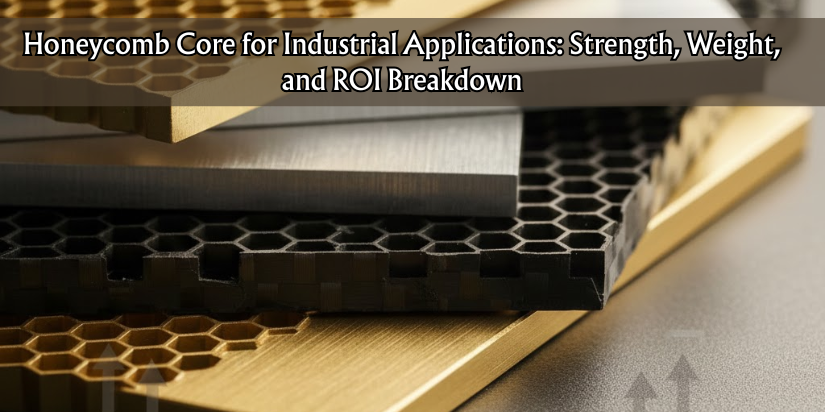
What is a honeycomb core?
A honeycomb core is a lightweight structure of hexagonal cells — made from aluminum, Nomex (aramid), paper/kraft, thermoplastic, or fiberglass (FRP). The cellular geometry is rigid yet light: it distributes load evenly and resists compression far better than its mass would suggest.
Why industry reaches for it
- Strength-to-weight — the hexagonal cell spreads mechanical stress uniformly, so the core carries large loads at minimal weight.
- Lightweight — less mass means better fuel economy, more aircraft payload, simpler installation, and lower structural demand on buildings.
- Compression & shear — strong out-of-plane, resistant to shear and to impact and vibration; ideal for aerospace panels, automotive crash structures, and marine flooring.
- Energy absorption — in defense and automotive use it acts as an impact absorber, protecting occupants in a collision.
- Corrosion & fire resistance — aluminum and Nomex variants shrug off corrosion, fire, moisture, and chemicals.
- Customization — density, cell size, material, and thickness all tune to the engineering requirement.
Where it's used, by industry
- Aerospace — floorboards, interior panels, rudders and wings, engine nacelles.
- Building & construction — facade cladding, curtain walls, ceiling and partition panels, cleanrooms.
- Marine — hulls, decks, bulkheads.
- Automotive & EV — crash structures, floor and roof panels, battery-pack protection.
- Defense & security — blast-absorption panels, military vehicle floors, shielding panels.
- Industrial machinery — workstation tables, conveyors, machine enclosures, noise-insulation panels.
Strength, weight & ROI at a glance
| Factor | Performance | Benefit | ROI impact |
|---|---|---|---|
| Strength-to-weight | Very high (hexagonal geometry) | Carries high loads without mass | Lower transport fuel cost; easier install |
| Weight reduction | Up to 80% lighter than solid panels | Reduced structural load | Less material and labor cost |
| Compression strength | Excellent out-of-plane | Ideal for structural panels | Longer life, fewer replacements |
| Shear strength | High shear resistance | Stable under dynamic loads | Durability in aerospace & automotive |
| Corrosion / fire | Strong in aluminum & Nomex | Suits harsh environments | Reduced maintenance cost |
| Customization | Variable cell, density, thickness | Fits many industries | Higher production efficiency |
| Cost efficiency | Low material use, high performance | Economical vs. solid materials | High long-term ROI |
Why the numbers pay back
- Reduced weight lowers operating cost — less fuel, more payload, fewer emissions penalties in aerospace, automotive, and marine.
- Longer material life — resistance to impact, moisture, fire, and corrosion cuts maintenance and replacement.
- Easier fabrication and install — lighter parts mean less labor and faster project completion.
- Improved safety — impact absorption reduces injury and damage in a crash.
- Durability in extreme environments — holds up under heat, fire, vibration, and marine exposure.
Where the technology is heading
As lightweighting and sustainable manufacturing become priorities, demand keeps growing. Emerging directions include 3D-printed honeycomb structures, bio-based cores, enhanced fire-resistant composites, and nanotechnology-infused honeycomb.
Whatever the application, the specification comes down to the same levers — material, cell size, density, and thickness. Tell us the load, the environment, and the weight target, and we'll cut a core to match.
Adapted from our parent company, DMC RF — read the original.